Precision gets complicated at Advanced Laser Skin Clinic
Laser suggests a narrow target. GHK’s gene-expression record leads me into a busier question: which of its many reported changes matters to skin?
The expression survey
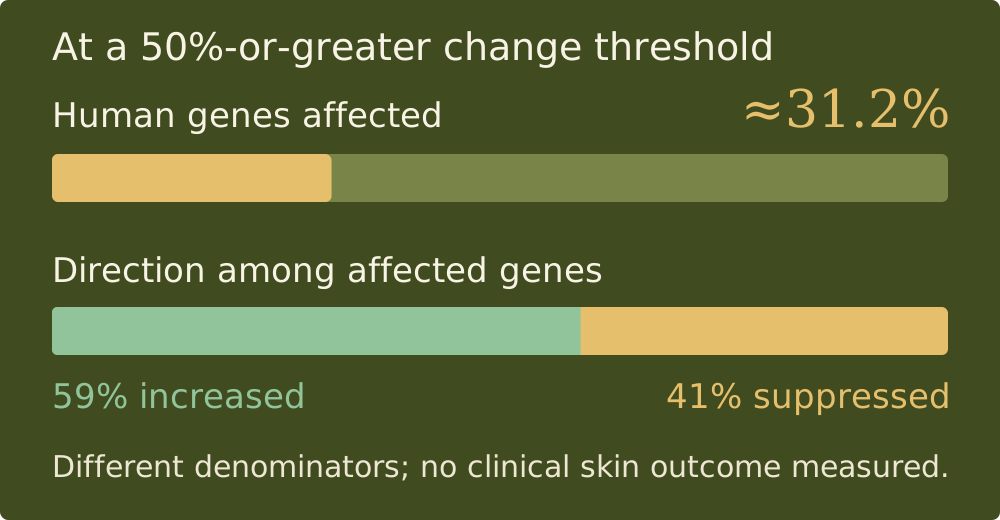
A review of GHK gene-expression data reports changes in approximately 31.2% of human genes at a 50%-or-greater change threshold. Of the affected genes, 59% had increased expression and 41% had suppressed expression. This is gene-expression and database analysis, with cell-culture validation, a long way from a measurement of someone’s skin.
The breadth unsettles me precisely because tidy explanations appeal to me. A familiar story might give a peptide a target and a tidy job. Here the reported changes span tissue-repair, protein-quality-control, DNA-repair and antioxidant programmes. The abundance intrigues me and sends my curiosity straight to the next experiment. Which change accounts for which observable effect?
Breadth at the stated threshold
The figures below preserve the review’s threshold and its separate split among affected genes. The percentage of genes affected and the direction of expression among those genes have different denominators. Neither is a percentage improvement in skin.
A wide molecular response earns neither my approval nor my disapproval on breadth alone. It gives a proposed explanation more work to do. The prospect that excites me is a connection between a defined molecular change and a defined tissue outcome, with the preparation and experimental setting still attached.
Specific outcomes in skin research
The gene-expression discussion stays with that broad signal. The collagen experiment has a narrower attraction: production increased without a change in cell number. Skin penetration introduces another kind of precision, because detecting copper raises a question about the chemical form at the destination.
The human findings deserve equal specificity. The topical review reports the proportion of subjects with a synthesis increase. The hair-count trial tested a combination containing GHK. Each result feeds my curiosity on its own terms.
A precise-sounding name makes the subject pleasantly unruly to me. The explanation I want must accommodate the broad signal and still say something exact about skin. The reading list gathers the experiments; about this publication explains the clinic-sounding title.